
Introduction
In today’s competitive digital landscape, businesses constantly seek effective ways to attract customers, increase website traffic, and generate sales. Two of the most powerful digital marketing strategies are Search Engine Optimization (SEO) and Paid Advertising (PPC). While both methods can drive traffic and conversions, they operate differently and offer unique advantages.
Many business owners face a common question: Should I invest in SEO or Paid Advertising?
The answer depends on your goals, budget, timeline, and target audience. Understanding the strengths and limitations of each strategy can help you make informed decisions and maximize your marketing return on investment (ROI).
In this comprehensive guide, we’ll compare SEO and Paid Advertising, explore their benefits and drawbacks, and help you determine which strategy is best for your business.
Understanding SEO
Search Engine Optimization (SEO) is the process of improving your website’s visibility in organic (non-paid) search engine results. The goal is to rank higher on search engines like Google when users search for relevant keywords.
For example, if someone searches:
- Best digital marketing agency
- SEO services near me
- Affordable web design company
A well-optimized website can appear among the top search results without paying for each click.
How SEO Works
SEO involves multiple techniques, including:
Keyword Research
Identifying terms your audience is searching for.
On-Page SEO
Optimizing website content, titles, headings, and meta descriptions.
Technical SEO
Improving website speed, mobile responsiveness, and site structure.
Content Marketing
Creating valuable blog posts, guides, and resources.
Link Building
Earning backlinks from reputable websites.
Local SEO
Optimizing your business for local searches and Google Business Profile.
Benefits of SEO
1. Long-Term Traffic Growth
One of SEO’s biggest advantages is sustainability.
Once your website ranks well, it can continue generating traffic for months or even years without ongoing advertising costs.
Example
A blog post ranking on Google’s first page can attract thousands of visitors every month at no additional cost.
2. Higher Trust and Credibility
Most users trust organic search results more than paid advertisements.
Ranking naturally signals authority and credibility.
Customers often perceive businesses appearing organically as more reliable than those relying solely on ads.
3. Better Return on Investment
Although SEO requires time and effort initially, the long-term ROI can be exceptional.
Unlike paid advertising, you don’t pay for every visitor who clicks your website.
4. Consistent Lead Generation
A strong SEO strategy creates a steady flow of qualified traffic.
These visitors are actively searching for products or services, making them more likely to convert.
5. Improved User Experience
SEO encourages businesses to improve website performance.
Benefits include:
- Faster loading pages
- Better mobile usability
- Improved navigation
- Enhanced content quality
These improvements benefit both search engines and customers.
Challenges of SEO
While SEO offers many advantages, it also comes with challenges.
Slow Results
SEO typically takes 3–6 months before significant improvements become visible.
Highly competitive industries may require even longer.
Constant Algorithm Updates
Google frequently updates its search algorithms.
Businesses must continuously adapt their SEO strategies.
Ongoing Effort Required
SEO is not a one-time activity.
Regular content creation and optimization are necessary to maintain rankings.
Understanding Paid Advertising (PPC)
Paid Advertising, commonly known as Pay-Per-Click (PPC), involves paying search engines or social media platforms to display advertisements.
Popular platforms include:
- Google Ads
- Facebook Ads
- Instagram Ads
- LinkedIn Ads
- YouTube Ads
Businesses pay when users click on their advertisements.
How Paid Advertising Works
Advertisers bid on keywords related to their products or services.
When users search for those keywords, ads appear above organic search results.
Example
If someone searches:
“Digital marketing agency”
Paid ads often appear before organic listings.
This allows businesses to gain immediate visibility.
Benefits of Paid Advertising
1. Instant Traffic
The biggest advantage of PPC is speed.
Unlike SEO, which takes months, paid ads can start generating traffic within hours.
This makes PPC ideal for:
- New businesses
- Product launches
- Promotional campaigns
- Seasonal offers
2. Highly Targeted Audience
Advertising platforms provide advanced targeting options.
You can target users based on:
- Location
- Age
- Gender
- Interests
- Search behavior
- Device usage
This precision improves campaign effectiveness.
3. Fast Lead Generation
Businesses seeking immediate leads often benefit from PPC.
Well-optimized campaigns can generate inquiries and sales quickly.
4. Easy Performance Tracking
Paid advertising provides detailed analytics.
Businesses can monitor:
- Clicks
- Conversions
- Cost per click
- Return on ad spend
- Customer acquisition costs
This data helps optimize future campaigns.
5. Scalability
Businesses can increase advertising budgets to generate more traffic and sales.
Scaling campaigns is often faster than improving SEO rankings.
Challenges of Paid Advertising
1. Continuous Costs
Traffic stops immediately when advertising budgets run out.
Unlike SEO, PPC does not provide lasting visibility.
2. Increasing Competition
Popular industries often have expensive keywords.
Businesses may face rising advertising costs over time.
3. Ad Fatigue
Users may become less responsive to repetitive advertisements.
Creative updates are necessary to maintain performance.
4. Requires Expertise
Poorly managed campaigns can waste significant amounts of money.
Effective PPC management requires:
- Keyword research
- Ad copywriting
- Bid management
- Conversion tracking
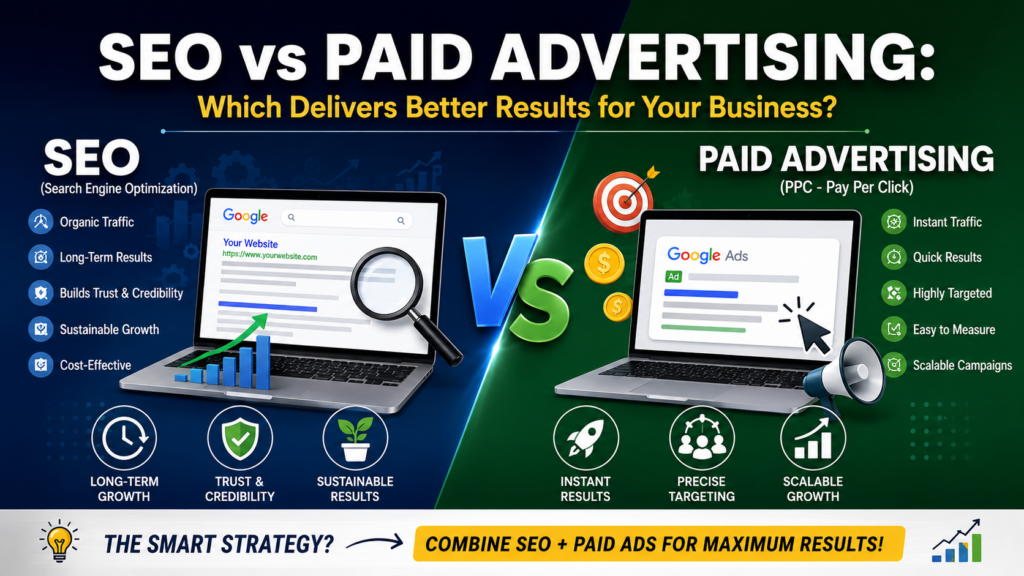
SEO vs Paid Advertising: Direct Comparison
| Factor | SEO | Paid Advertising |
|---|---|---|
| Cost | Lower long-term cost | Ongoing expense |
| Speed | Slow results | Immediate results |
| Trust | High credibility | Moderate credibility |
| Traffic Duration | Long-lasting | Stops when budget ends |
| ROI | Strong long-term ROI | Fast short-term ROI |
| Scalability | Gradual growth | Rapid growth |
| Lead Generation | Sustainable | Immediate |
| Brand Authority | High | Moderate |
Which Strategy Is Better for Small Businesses?
Small businesses often have limited budgets.
For most small businesses:
SEO is ideal if:
- You want long-term growth.
- You have limited advertising budgets.
- You want sustainable traffic.
- You focus on local customers.
PPC is ideal if:
- You need immediate leads.
- You are launching a new service.
- You have a competitive market.
- You need quick visibility.
The Best Approach: Combining SEO and Paid Advertising
Many successful businesses don’t choose one over the other.
Instead, they use both strategies together.
Why Combining Both Works
SEO provides:
- Long-term visibility
- Sustainable traffic
- Brand authority
Paid Advertising provides:
- Immediate traffic
- Fast lead generation
- Testing opportunities
Example Combined Strategy
Month 1-3
Focus heavily on PPC to generate immediate leads.
Meanwhile:
- Build website content
- Optimize SEO
- Publish blogs
Month 4-6
SEO rankings begin improving.
Reduce dependency on paid ads.
Month 6+
SEO generates consistent traffic.
Use PPC strategically for:
- Promotions
- Retargeting campaigns
- High-converting keywords
This balanced approach maximizes results while controlling costs.
Key Questions to Ask Before Choosing
Before deciding between SEO and PPC, consider:
What is your marketing budget?
Limited budget → SEO
Larger budget → SEO + PPC
How quickly do you need results?
Immediate results → PPC
Long-term growth → SEO
What is your competition level?
Highly competitive industries often require both.
What are your business goals?
Brand awareness → SEO
Fast sales → PPC
Maximum growth → Combination strategy
Future Trends in SEO and Paid Advertising
As digital marketing evolves, businesses should prepare for:
AI-Powered Search
Search engines are becoming smarter and more personalized.
Voice Search Optimization
Conversational search queries are increasing.
Automated Advertising
AI is improving campaign targeting and optimization.
Privacy-Focused Marketing
First-party data will become increasingly valuable.
Businesses that adapt to these changes will gain a competitive advantage.
Conclusion
SEO and Paid Advertising are both powerful marketing channels, but they serve different purposes.
SEO is a long-term investment that builds credibility, authority, and sustainable traffic. Paid Advertising delivers immediate visibility, faster lead generation, and precise audience targeting.
For businesses seeking long-term growth, SEO is essential. For businesses needing quick results, PPC is highly effective.
The most successful companies often combine both strategies to maximize visibility, generate consistent leads, and achieve sustainable growth.
Instead of viewing SEO and Paid Advertising as competitors, think of them as complementary tools that work together to strengthen your digital marketing strategy.
Frequently Asked Questions (FAQs)
Is SEO better than Google Ads?
SEO offers better long-term value, while Google Ads provide faster results. The best choice depends on your goals.
How long does SEO take to show results?
Most businesses begin seeing noticeable improvements within 3–6 months.
Are Google Ads worth the investment?
Yes, when properly managed, Google Ads can generate highly targeted traffic and leads.
Can I do SEO and PPC together?
Absolutely. Combining both strategies often produces the best overall results.
Which is cheaper: SEO or Paid Advertising?
SEO generally costs less over the long term, while Paid Advertising requires ongoing spending to maintain traffic and visibility.