
T
Digital marketing continues to evolve at an unprecedented pace. With changing consumer behavior, advancements in artificial intelligence, and increasing competition across industries, businesses must adapt their marketing strategies to remain competitive. In 2026, success will depend on a combination of data-driven decision-making, personalized customer experiences, and innovative digital channels.
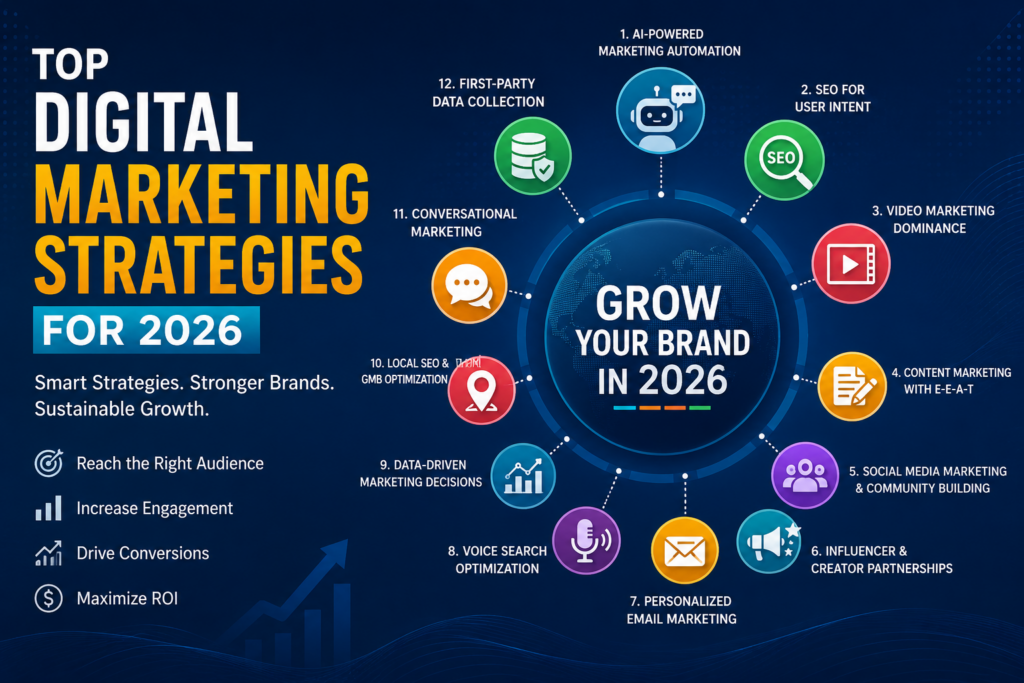
This guide explores the top digital marketing strategies that businesses should implement to drive growth, improve brand visibility, and maximize return on investment (ROI).
1. AI-Powered Marketing Automation
Artificial Intelligence (AI) is transforming the way businesses interact with customers. From automated email campaigns to predictive analytics and customer support chatbots, AI enables marketers to deliver personalized experiences at scale.
Benefits:
- Improved customer engagement
- Faster response times
- Better audience segmentation
- Increased marketing efficiency
Businesses that integrate AI into their marketing efforts can automate repetitive tasks and focus more on strategy and creativity.
2. Search Engine Optimization (SEO) for User Intent
SEO remains one of the most effective digital marketing strategies in 2026. However, search engines are now prioritizing user intent and content quality over simple keyword optimization.
SEO Best Practices:
- Create comprehensive and valuable content
- Optimize for voice search
- Improve website speed and mobile performance
- Focus on long-tail keywords
- Build high-quality backlinks
Companies that consistently publish helpful content and provide excellent user experiences are more likely to achieve higher rankings in search results.
3. Video Marketing Dominance
Video content continues to generate the highest engagement across digital platforms. Short-form videos, educational content, live streams, and product demonstrations help businesses connect with audiences more effectively.
Popular Video Formats:
- Short-form videos
- Behind-the-scenes content
- Customer testimonials
- Product tutorials
- Live Q&A sessions
Video marketing helps increase brand awareness, improve engagement, and boost conversion rates.
4. Content Marketing with E-E-A-T Principles
Search engines increasingly reward content that demonstrates Experience, Expertise, Authoritativeness, and Trustworthiness (E-E-A-T).
Effective Content Types:
- Blog articles
- Case studies
- Industry reports
- Expert interviews
- Educational guides
Businesses should focus on creating content that solves real customer problems rather than producing content solely for search rankings.
5. Social Media Marketing and Community Building
Social media is no longer just a promotional tool. Successful brands are using platforms to build communities, encourage conversations, and establish long-term customer relationships.
Key Strategies:
- Engage with followers regularly
- Share user-generated content
- Use interactive polls and stories
- Collaborate with influencers
- Create platform-specific content
Brands that foster authentic engagement are more likely to gain loyal customers and increase brand advocacy.
6. Influencer and Creator Partnerships
Consumers trust recommendations from people more than traditional advertisements. Collaborating with influencers and content creators helps brands reach targeted audiences with greater authenticity.
Why It Works:
- Builds trust quickly
- Increases brand exposure
- Drives engagement
- Supports product launches
Micro-influencers, in particular, often deliver higher engagement rates and stronger audience connections.
7. Personalized Email Marketing
Email marketing remains one of the highest ROI-generating digital channels. Modern email campaigns rely heavily on personalization and customer behavior data.
Email Marketing Tips:
- Segment your audience
- Personalize subject lines
- Automate customer journeys
- Send relevant content
- Optimize for mobile devices
Personalized emails can significantly improve open rates, click-through rates, and conversions.
8. Voice Search Optimization
As voice assistants become more integrated into daily life, optimizing content for voice search is becoming increasingly important.
Optimization Techniques:
- Use conversational language
- Answer common questions directly
- Target long-tail keywords
- Optimize local SEO listings
Businesses that adapt their content for voice search can capture valuable organic traffic opportunities.
9. Data-Driven Marketing Decisions
Modern marketing success depends on analyzing customer data and campaign performance.
Important Metrics:
- Website traffic
- Conversion rates
- Customer acquisition cost
- Return on ad spend
- Customer lifetime value
Using analytics tools helps businesses make informed decisions and continuously improve their marketing strategies.
10. Local SEO and Google Business Profile Optimization
For local businesses, visibility in local search results is critical.
Local SEO Best Practices:
- Optimize Google Business Profile
- Collect customer reviews
- Use location-specific keywords
- Maintain consistent business information
- Create local content
A strong local SEO strategy helps businesses attract nearby customers and increase foot traffic.
11. Conversational Marketing
Customers expect immediate responses and personalized communication. Conversational marketing uses chatbots, messaging apps, and live chat tools to engage users in real time.
Benefits:
- Faster customer support
- Better lead qualification
- Higher customer satisfaction
- Improved conversion rates
Real-time interactions help businesses build stronger customer relationships.
12. First-Party Data Collection
As privacy regulations continue to evolve, businesses are relying more on first-party data collected directly from customers.
Collection Methods:
- Email subscriptions
- Customer surveys
- Loyalty programs
- Website interactions
First-party data provides valuable insights while maintaining compliance with privacy regulations.
The Future of Digital Marketing
The future of digital marketing will be shaped by personalization, automation, and customer-centric experiences. Businesses that embrace emerging technologies while focusing on delivering value to customers will be best positioned for long-term success.
Rather than relying on a single channel, successful marketers in 2026 will combine SEO, content marketing, social media, video, AI, and data analytics into an integrated strategy that delivers measurable results.
Conclusion
Digital marketing in 2026 is more dynamic and competitive than ever. Businesses that invest in AI-powered automation, high-quality content, video marketing, SEO, and personalized customer experiences can build stronger brands and achieve sustainable growth.
The key to success lies in understanding your audience, adapting to changing trends, and consistently delivering value across every digital touchpoint. By implementing these strategies, businesses can stay ahead of the competition and thrive in the evolving digital landscape.
Looking to grow your business online? A well-planned digital marketing strategy can help increase visibility, generate qualified leads, and drive long-term success.