
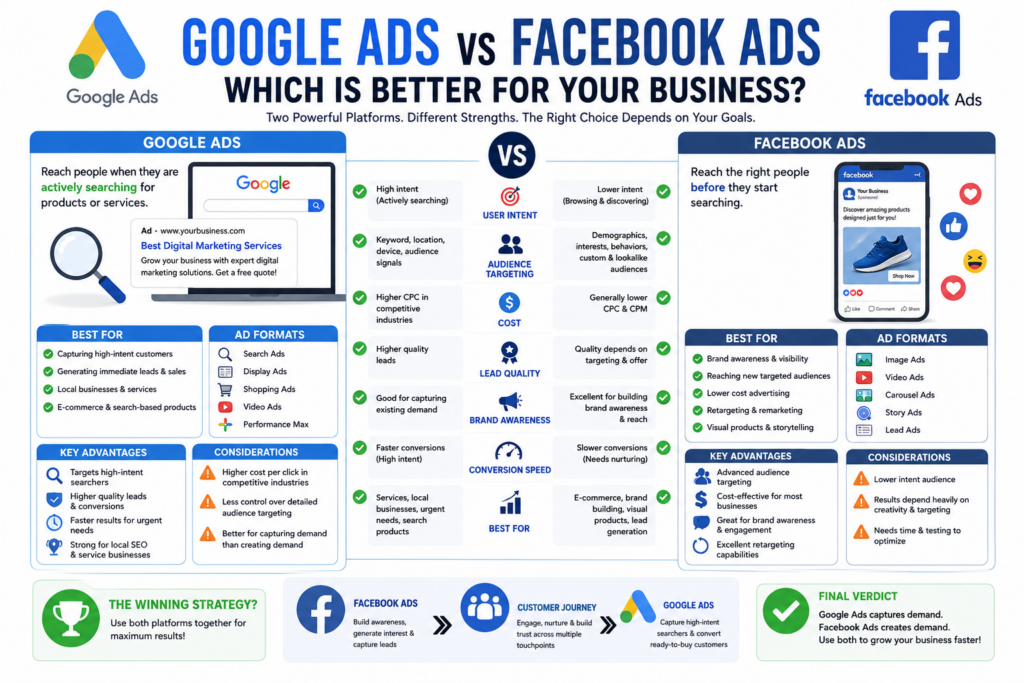
In today’s competitive digital landscape, online advertising has become one of the most effective ways for businesses to attract customers, generate leads, and increase sales. Among the many advertising platforms available, Google Ads and Facebook Ads remain the two most powerful and widely used options.
However, many business owners struggle with a common question:
“Should I invest in Google Ads or Facebook Ads?”
The answer depends on your business goals, target audience, budget, and marketing strategy. Both platforms offer unique advantages and can deliver excellent results when used correctly.
In this comprehensive guide, we’ll compare Google Ads and Facebook Ads in detail to help you determine which platform is best for your business.
Understanding Google Ads
Google Ads is Google’s online advertising platform that allows businesses to display ads across Google’s search engine, YouTube, Gmail, and partner websites.
The most popular type of Google Ads is Search Advertising, where businesses bid on keywords related to their products or services.
For example, when someone searches:
- “Digital marketing agency near me”
- “Best SEO services”
- “Website development company”
Google displays relevant ads at the top of search results.
Key Advantage
Google Ads targets users who are actively searching for a solution.
This means customers already have purchase intent when they see your advertisement.
Understanding Facebook Ads
Facebook Ads is a paid advertising platform operated by Meta that allows businesses to advertise across:
- Messenger
- Audience Network
Unlike Google Ads, Facebook Ads focus on audience targeting rather than search intent.
Facebook uses user data such as:
- Interests
- Demographics
- Online behavior
- Purchase history
- Location
to show ads to relevant audiences.
Key Advantage
Facebook Ads help businesses create demand by reaching users before they start searching for products or services.
Google Ads vs Facebook Ads: Major Differences
1. User Intent
Google Ads
Google users actively search for information, products, or services.
For example:
Someone searching for:
“Emergency plumber near me”
likely needs immediate assistance.
Google Ads capture this high-intent traffic.
Facebook Ads
Facebook users are typically browsing social content rather than actively searching for products.
Ads interrupt their browsing experience and introduce them to new products or services.
Winner: Google Ads
For immediate leads and sales, Google Ads generally performs better because users already have buying intent.
2. Audience Targeting
Google Ads
Google primarily targets users based on:
- Search keywords
- Location
- Device
- Audience signals
Facebook Ads
Facebook offers extremely detailed targeting options:
- Age
- Gender
- Interests
- Behaviors
- Job titles
- Income levels
- Relationship status
- Custom audiences
- Lookalike audiences
Winner: Facebook Ads
Facebook provides more advanced audience targeting capabilities.
3. Cost Comparison
Advertising costs vary depending on industry and competition.
Google Ads
Highly competitive industries often have expensive keywords.
Examples:
- Legal Services
- Insurance
- Real Estate
- Finance
Some keywords can cost hundreds of dollars per click.
Facebook Ads
Facebook advertising generally offers lower costs:
- Lower CPC (Cost Per Click)
- Lower CPM (Cost Per Thousand Impressions)
Winner: Facebook Ads
For businesses with limited budgets, Facebook often provides more affordable advertising opportunities.
4. Lead Quality
Google Ads
Since users are actively searching for solutions, lead quality tends to be higher.
Examples:
- Home services
- Local businesses
- Medical clinics
- B2B services
Facebook Ads
Lead quality can vary significantly depending on targeting and offer quality.
Winner: Google Ads
Google generally produces higher-quality leads.
5. Brand Awareness
Google Ads
Excellent for capturing existing demand.
Less effective for introducing completely new brands.
Facebook Ads
Outstanding for:
- Brand awareness
- Product discovery
- Storytelling
- Visual engagement
Businesses can showcase products through images, videos, and interactive content.
Winner: Facebook Ads
Facebook excels at building brand awareness.
6. Ad Formats
Google Ads Formats
- Search Ads
- Display Ads
- Shopping Ads
- Video Ads
- App Promotion Ads
- Performance Max Campaigns
Facebook Ads Formats
- Image Ads
- Video Ads
- Carousel Ads
- Story Ads
- Reels Ads
- Collection Ads
- Lead Generation Ads
Winner: Facebook Ads
Facebook offers more creative and visually engaging ad formats.
7. Conversion Speed
Google Ads
Conversions often happen faster because users already need the product or service.
Facebook Ads
Customers may require multiple touchpoints before converting.
Winner: Google Ads
Google typically generates faster results.
8. Best Industries for Google Ads
Google Ads performs exceptionally well for:
Local Businesses
- Dentists
- Plumbers
- Electricians
- HVAC services
Professional Services
- Lawyers
- Consultants
- Marketing agencies
- Accountants
E-commerce
- Product searches
- Shopping campaigns
Healthcare
- Clinics
- Hospitals
- Specialists
9. Best Industries for Facebook Ads
Facebook Ads performs exceptionally well for:
Fashion Brands
Visual products thrive on social media.
Fitness Businesses
Gyms, trainers, and wellness brands benefit from audience targeting.
Beauty Industry
Skincare, cosmetics, and salons perform well.
Online Courses
Educational businesses can generate leads at lower costs.
Restaurants
Local promotions and special offers work effectively.
SEO Perspective: Which Platform Helps More?
Neither Google Ads nor Facebook Ads directly improve SEO rankings.
However:
Google Ads
Can increase:
- Website traffic
- Brand awareness
- Search demand
Facebook Ads
Can improve:
- Content visibility
- Social engagement
- Brand recognition
A strong SEO strategy combined with paid advertising delivers the best long-term results.
ROI Comparison
Google Ads ROI
Best when:
- Customers actively search for solutions
- Services solve urgent problems
- High-intent keywords exist
Facebook Ads ROI
Best when:
- Building brand awareness
- Retargeting website visitors
- Launching new products
- Creating demand
The platform with the best ROI depends on your business model.
When Should You Choose Google Ads?
Choose Google Ads if:
✅ You want immediate leads
✅ You offer services people actively search for
✅ You have a strong sales funnel
✅ Your business relies on local customers
✅ You need high-intent traffic
When Should You Choose Facebook Ads?
Choose Facebook Ads if:
✅ You want brand awareness
✅ You sell visually appealing products
✅ You have a smaller advertising budget
✅ You want advanced audience targeting
✅ You want to build long-term customer relationships
Why Many Businesses Use Both
The most successful businesses don’t choose one platform—they use both.
Example Strategy
Facebook Ads
- Build awareness
- Generate interest
- Capture leads
Google Ads
- Capture purchase intent
- Convert ready-to-buy customers
This creates a complete customer journey.
A potential customer might first discover your business on Facebook and later search for your brand on Google before making a purchase.
The Future of Digital Advertising
As AI continues transforming digital marketing, both Google and Meta are introducing smarter automation tools.
Future trends include:
- AI-powered ad optimization
- Predictive audience targeting
- Personalized advertising
- Enhanced automation
- Better attribution tracking
Businesses that adapt to these changes will gain a significant competitive advantage.
Final Verdict: Which Is Better?
There is no universal winner between Google Ads and Facebook Ads.
Choose Google Ads if:
- You need immediate leads.
- Customers actively search for your services.
- Lead quality is your priority.
Choose Facebook Ads if:
- You want to build brand awareness.
- You need advanced audience targeting.
- Your products are visually appealing.
Best Strategy:
For most businesses, the ideal approach is using Google Ads and Facebook Ads together. Facebook generates awareness and interest, while Google captures high-intent buyers ready to take action.
By combining both platforms, businesses can maximize visibility, generate quality leads, and achieve sustainable growth in an increasingly competitive digital marketplace.
Need help running profitable Google Ads or Facebook Ads campaigns? A strategic digital marketing plan can help your business attract more customers, increase conversions, and maximize advertising ROI. 🚀